
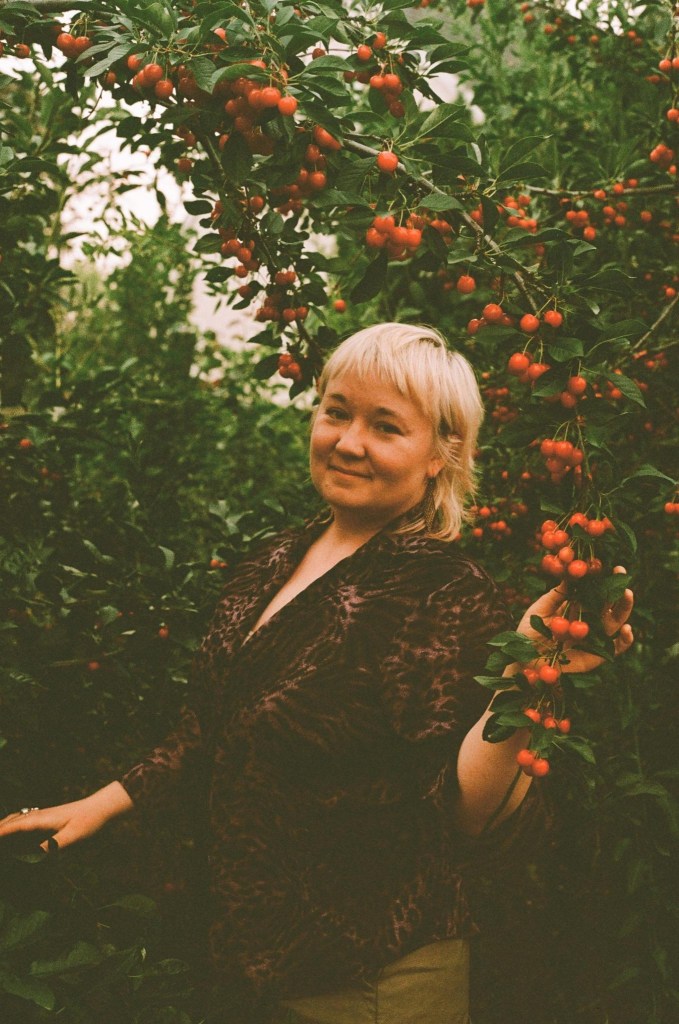
Written by Rachel Stewart, Content Director and Co-Founder
“Creating together is stronger than creating alone.” For Edmonton-based artist Mika Haykowsky, this isn’t just a nice sentiment, it’s the driving force behind everything she does. I sat down with Mika to talk about community, collaboration, and what it means to expand your practice beyond yourself. From sidewalk chalk murals that reclaim public space to grant-writing sessions that transform artists’ dreams into funded realities, Mika is on a mission to prove that art doesn’t have to be a solitary pursuit.
This interview has been edited and condensed for clarity.
Let’s start at the beginning. Mika, tell me about your journey to becoming an artist.
Where do I start? I grew up with creativity being the norm. My Parents are both artsy; I share my pottery studio with my dad, and I have duo art shows with my mom. My mom’s an artist and my dad’s a writer, and my dad sometimes does pottery with me too.
I also excelled at art in school. I remember, it was the end of junior high and we were doing farewell cards for our classmates where we had to write one or two words that described the person. Almost everybody in my class just wrote “art,” or, “good art,” and I was like, “that’s not a descriptor, but okay, haha.” Seeing other people realize this about me helped me realize it about myself.
Then in high school, I was fortunate enough to learn some Adobe programs in graphic design and photography classes. That was life changing for me. I excelled and I actually got the award for highest mark in graphic design, which was 100%. I’m still really proud of that. About a year after graduation, my mom and I did my first art show showcasing my photography.
After high school, I went straight into university, which was a little hasty. I got into the industrial design program. I applied to the University of Alberta for industrial design. I wanted to challenge myself beyond just the visual communication design and see what 3D design could be, to not just do something I knew I could do. Pretty soon, I learned this was not for me. I saw it as primarily product and furniture design, which is fine but I wasn’t inspired by either at all. As a program requirement, I had to take a few fine arts classes like art history, and intermedia art classes, which is are a class for all the mediums that don’t fit into classic categories. This includes, like performance art, soundscapes, audio, photography, installation, mixed media, etc. I was introduced to these different art forms and it just completely blew my mind. And I started to excel at it because I understood that you could have a concept behind what you were doing. I was super interested in things like gender expression, especially childhood gender expression , performance of femininity, and masking. I withdrew myself from industrial design and reapplied into fine arts and I graduated with a Bachelor of Fine Arts in 2016. I Simultaneously, I was also got to take in art history classes, where I met THE BEST my favourite professor of all time, Dr. Natalie Loveless. She introduced me to “research creation”, which is where you create an art piece something that goes along with your research paper. I loved that. I was so inspired. I got to create a performance art video that was a reaction to a past artwork. This piece became my graduation piece at the final exhibition. It came together so well and was such a strong piece that I used it in our grad show. Eventually, I withdrew myself from industrial design and reapplied into fine arts and I graduated with a Bachelor of Fine Arts in 2016.
These research-based creations (and the papers that went along with them!) had me excitedly on the path to an art career in academia, dreaming of being a professor. For my master’s degree, I studied at the Trondheim Academy of Art, graduating in 2019. While in Norway I was nursing a long-distance relationship with a 9-hour time difference. I was really interested in the modern tools we have to “connect” and share ourselves with the people we love, so my research topic, naturally, was technology and intimacy. This theme continued in the coming years with the pandemic: a perfect social rupture that left us all craving togetherness. Touch, bodies, membranes, isolation, and being a “risk” are still things I think about a lot, even though this era feels over. I left hungry for bigger artistic challenges, and the experience itself was amazing. The nature in Norway is just incredible and I made amazing friends.
Superspreader exhibition more photos on my website
You work across so many mediums. What draws you to such a multidisciplinary approach?
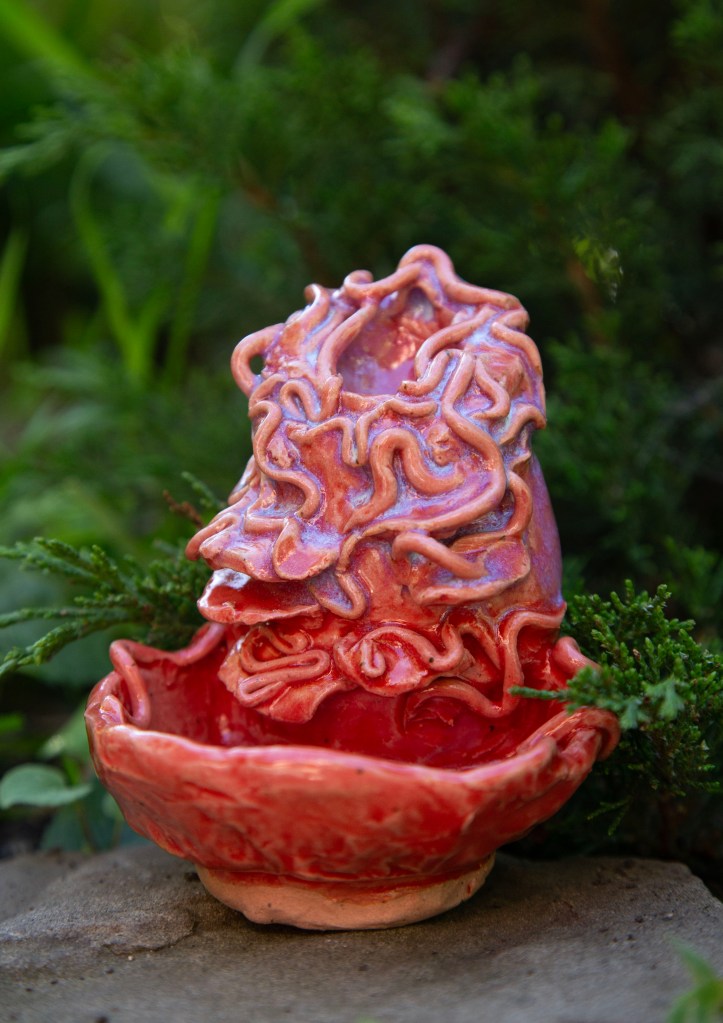
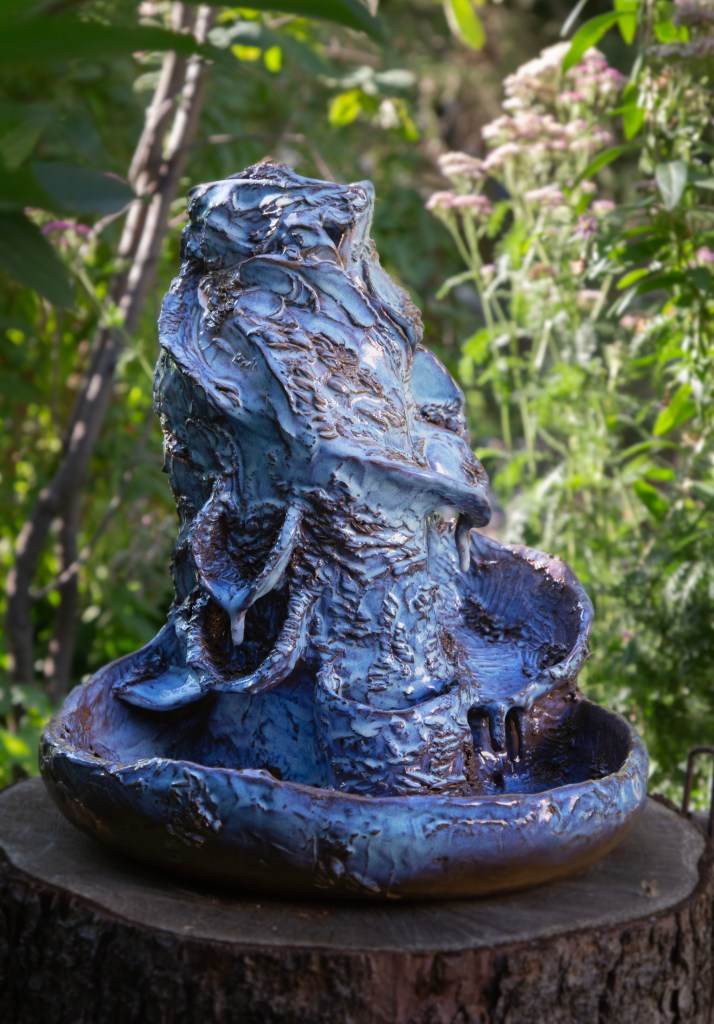
Oh, that’s such a hard question. Basically, I don’t like to be limited or restricted in the mediums I use, but I also find that limiting yourself can be useful. Currently, I’m mostly just doing ceramics in preparation for my art show at the McMullan Gallery in January 2026. I am building fountains, which I guess are multimedia because th.
Tell us about the Mika Method. What inspired you to create this business?
I enjoy writing and have been successful in grant writing for myself. I like the process of flushing things out and formulating things in a way that tells a story about a project or about the person themselves. Kind of what ROSE is doing, actually.
But the real lightbulb moment came in 2023 at a ceramics residency. I met a friend who’d never applied for a grant before. She wanted to build a kiln on her farm and I was like, “that’s awesome, how are you doing to do that?” She didn’t have a plan, so we sat down for coffee and I started asking questions, like: how many people would you need? How much money? What materials? Are you housing people while they work on the project? Feeding them? What’s the long-term vision for the community around the farm?
We spent an hour and a half sketching out plans and taking notes, basically creating a project template for her. And leaving that meeting, I just felt so alive. That energy of starting something, of seeing the potential – it’s incredible. I thought, “Maybe I can help people with this”.
About a year later, I took a self-employment training course and officially started the Mika Method. And grant writing is just one component – there are so many other pieces that I offer and expand on.
How would you describe that thrill of visioning what’s possible?
Flow-state. Hyper-focused, and elated. I get so inspired and invested in people’s dreams. With my friend’s kiln project, I’m still checking in like, “Are you gonna do it? There’s all this potential! Do you need help? I’ll come to Nova Scotia!”
The ultimate goal is seeing people’s dreams come true. When you’re doing these planning sessions, you get a glimpse of that – what that person really wants, what they want to offer people, what they’re struggling with. It’s powerful.
Tell me about the community engagement part of your work.
Creating together is stronger than creating alone. And art can be really accessible if it’s made that way.
One of my first curating pieces was a big chalk mural project at MacEwan University called “Take Back the Streets”. It was one of my first opportunities to create paid opportunities for other artists. I put out an open call, screened portfolios, and hired artists. It gave them income and a public art piece for their portfolio. Public art commissions are some of the biggest commissions artists can get; city-commissioned pieces for things like LRT stations, new buildings, recreation centers… These can be huge game-changers for artists.
With chalk specifically, it’s such a temporary medium. It has this ephemeral quality where you know it’s only going to be there as long as the weather permits. And it’s almost childlike – just getting down on the sidewalk is something almost anyone can do. It’s also a medium we associate with being outside, summertime, play… Carefree feelings. And we need more whimsy in our everyday lives!
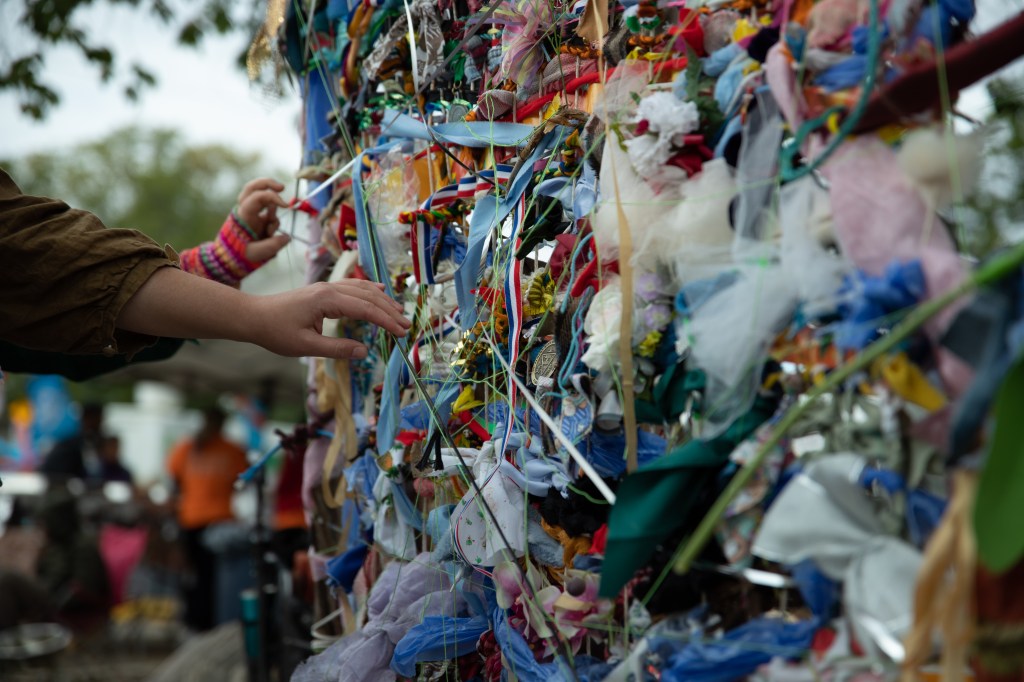
I also do community weaving projects with my collaborator, Breanna Barrington. These work differently. We built looms out of scrapwood, salvaged fabrics and materials, and invite participants asked different people to weave together and create a community tapestry using scrap fabric and found materials. Everyone contributes a little piece to the whole to create a community tapestry. It’s collaborative art in its prime.
That’s beautiful. It sounds like it’s the process that really resonates with you. Of course the process is in pursuit of a finished work of art, the process is its own reward.
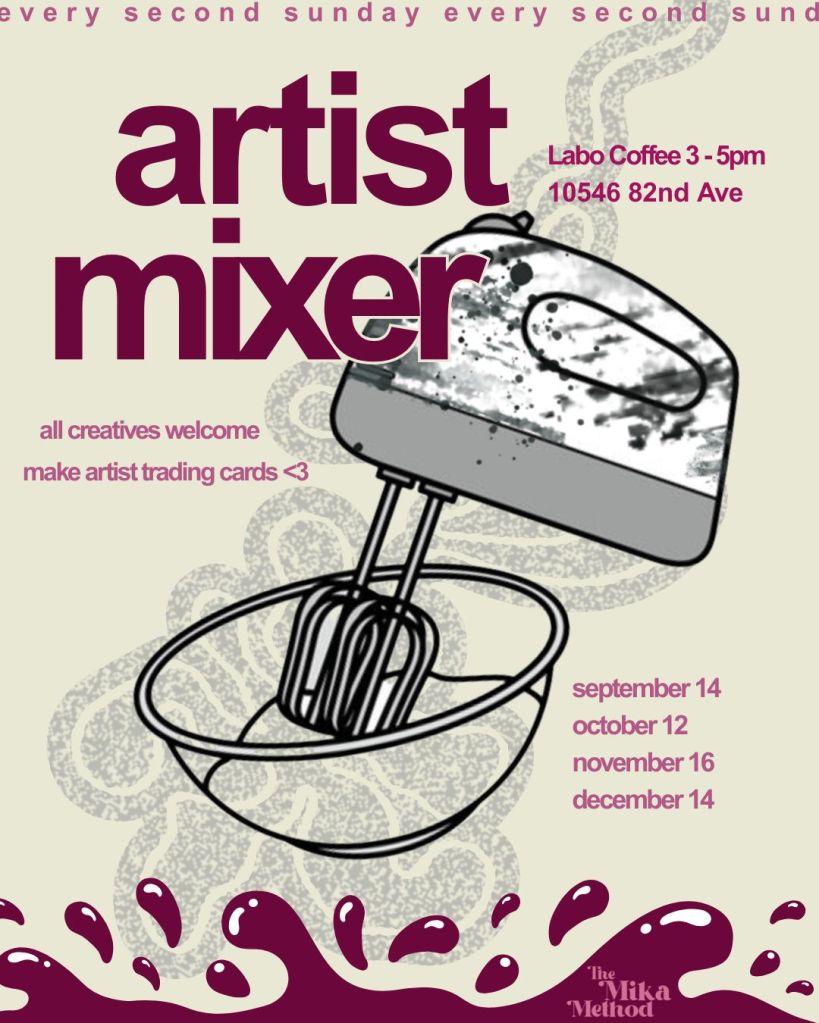
Yeah, I would say so. Building and strengthening our communities is so important especially right now with the loneliness epidemic and demands of modern life. People are feeling isolated, and I’ve been trying to get people together through different projects and artist mixers I host.
What does community mean to you?
I live in a housing co-operative. It’s essentially self-governed, shared housing. I live with four other people in one of the three houses we own collectively. My life is very much community. We call it a community house, and serving the community is one of our core values.
One way I support the community is I built a little free library in front of my house. It’s a space for people to trade books – a little gift economy where you can come across something and know it’s for you, no questions asked. If you want to give a book, you can, and if you want to take a book, you can. Little pockets of anti-capitalist, gift economy exchanges – that’s what I’m super interested in.
It sounds like belonging is a big part of what community means for you.
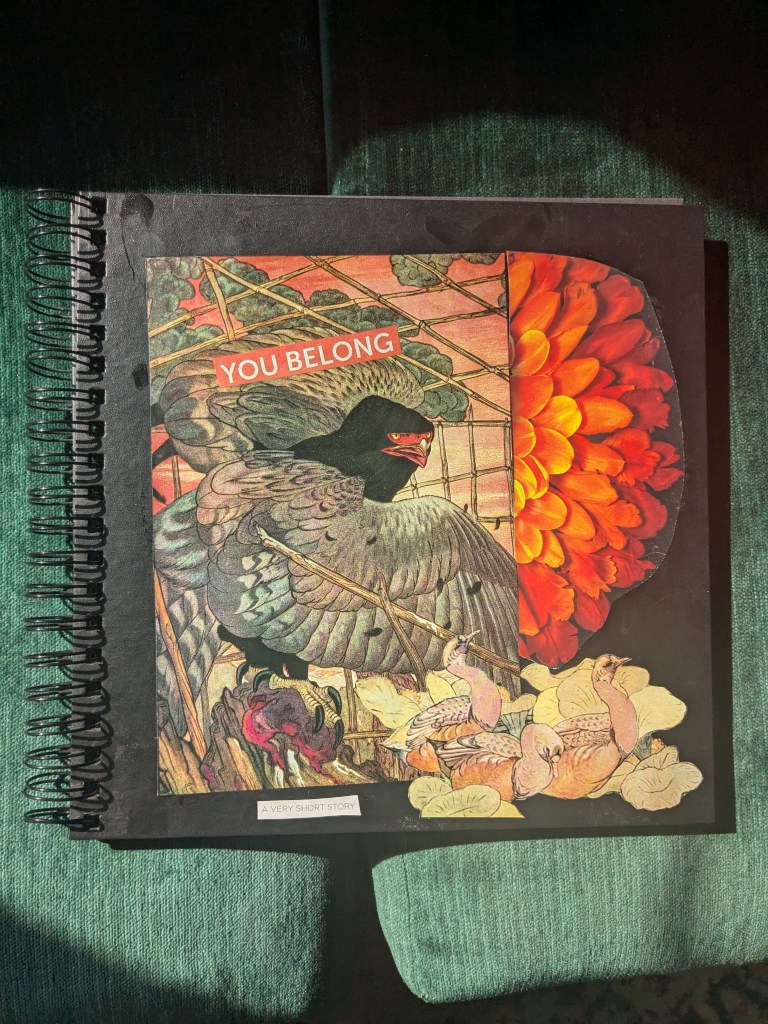
Yeah, actually. I try to bring that into my art practice through hosting free artist mixers. We created a shared sketchbook/guestbook where people can add collages, drawings, paintings, anything. The cover says, “You Belong: A Short Story”. Making people feel like they belong is a big value of mine.
What advice would you give to artists trying to balance their personal creative practice with supporting their community?
Skill sharing. If you have a practice you could teach other people, share it. Keep the economy of art accessible rather than having everything behind the paywall of art school or expensive courses. That’s part of what the artist mixer is about for me. We learn so much from just seeing other people try something new or watching their technique.
You’re writing an article for ROSE’s inaugural issue in May. What themes are you exploring?
Expansiveness. I’m an artist who’s opening my doors and expanding my practice to touch more people, include more people, engage and activate more people.
One thing I’ve noticed through starting the Mika Method is that my focus has shifted away from myself as an artist and onto the other person and their art practice. I’m still grappling with how to be both an artist and to serve other artists – how those things work together.
I’m also thinking about being essentially grant-funded for most of my career. I’m fortunate to be living off a grant right now while making sculptures for my show in January. There’s a story there about how artists sustain themselves.
What types of collaborators or projects are you hoping to connect with?
I started a Discord for artists called Constellation of Artists Expanding Resources or CAER. The acronym sounds like “care,” but a “caer” is also a pillar in a fortress, a stronghold. I love that idea of this foundation, this pillar for something. It might be indirect collaboration, but it’s a place to meet, share what we’re up to, maybe have monthly Zoom critiques or check-ins.
I’d also love to do mail art projects, like sending snail mail back and forth within the province. And I’m always looking for musicians. I’ve written some songs that I’d love other artists to collaborate on with me.
One of my goals with CAER and the artist mixers is to get artists together to do a group show. Even if anyone just wants to introduce themselves and their work by sharing their website or some pictures, that’s a good way to start.
After our conversation, I kept thinking about that moment Mika described… sitting across from her friend at the ceramics residency, asking question after question, watching a dream take shape. That’s Mika in a nutshell: an artist who finds as much joy in activating other people’s visions as creating her own. Whether she’s organizing chalk art that reclaims public space, building community tapestries, or helping artists navigate grant applications, she’s proving that art doesn’t have to be a solitary pursuit. In Mika’s world, creativity is a collective act, and everyone belongs there.
 ROSE Magazine Canada